The history of Lapu-Lapu

History has it that Mactan Island although small was a thriving community when the great Magellan was in Cebu. The brave Spanish navigator and soldier, upon learning that some inhabitants on this tiny island across Cebu refused to recognize the King of Spain, burned one of the villages. Lapu-Lapu was one of the native leaders who refused to acknowledge the sovereignty of Spain over the Islands.

When Magellan, with three boatloads of Spaniards and twenty boatloads of Cebuanos, went to Mactan to help a friendly chief, Lapu-Lapu and his men armed with native fighting elements, wooden shields, bows and arrows, lances, met them. The invading Spaniards and Cebuanos were driven back to their boats, but their brace leader, Magellan, met death in the hands of Lapu-Lapu. On what is believed to be the exact spot where Magellan fell and died now stands an imposing monument in honour of the gallant explorer.

In the 16th century Mactan Island was colonized by Spain. An Augustinians friar founded the town of Opon in 1730 and became a city in 1961 and was renamed after Datu Lapu-Lapu, a Muslim king who defeated Portuguese explorer Ferdinand Magellan in 1521. This battle is commemorated at the Lapu-Lapu shrine in Punta Engaño.

Politician Manuel A. Zosa, the representative of the Sixth District of Cebu, sponsored the Bill converting the former municipality of Opon into the present day City of Lapu-Lapu. This was the Republic Act 3134, known as the City Charter of Lapu-Lapu which was signed on June 17, 1961 by former Philippine President Carlos P. Garcia.

Lapu-Lapu is widely celebrated as the first Filipino hero, famously vanquishing Portuguese conquistador Ferdinand Magellan and his army in their attempt to colonise Mactan Island. In honor of his triumph, Lapu-Lapu’s monument stands tall in the island of Mactan today, symbolising the country’s first successful resistance to Spanish colonisation.

Apart from successfully defying foreign invaders, little is known about the man and legend that is Lapu-Lapu. Citing scholarly research and historical accounts, Culture Trip aims to paint a picture of this Philippine hero and the events that shaped the future of the nation.

Culture Trip asked locals in the Philippines what they thought about Lapu-Lapu, and they responded with terms like: “Brave Mactan Leader,” “Pinuno na may paninindigan” (leader who stood for his people) and “Leader who fought for his people.” His reputation precedes him, weaving history and myth into the fabric of modern Filipino culture.

Although the exact date of his arrival is unknown, most historical accounts state Lapu-Lapu reached the shores of Sugbo (now referred to as Cebu) from the neighboring island of Borneo. At this time, Rajah Humabon ruled over Sugbo and was recognized by natives as the island’s king. Lapu-Lapu asked Humabon for a place to settle in the archipelago; in response, the king offered him the region of Mandawili (known today as Mandaue), including the Opong area. He soon after became the chief of the region’s people — referred to as Datu Lapu-Lapu of Mactan island.

Locals held the Bornean native in high regard as one of their own. He defeated invading Bornean soldiers and pirates, helped enrich Sugbo’s trade port and stood up for his people. Things seemed to be going well. However, Lapu-Lapu’s good relationship with Rajah Humabon ‘deteriorated’ when he raided merchant ships in Opong area, changing the course of events to come.

Lapu-Lapu vs Ferdinand Magellan at The Battle of Mactan

Lapu-Lapu is also known under the names of Cilapulapu, Si Lapulapu, Salip Pulaka, Cali Pulaco, and LapuLapu Dimantag. And while historians can’t unanimously agree on his real name, the man has always been etched in history for his battle against Portuguese explorer and conquistador Ferdinand Magellan.

In 1521, Ferdinand Magellan unintentionally stumbled upon Homonhon Island (known today as Samar) while he was en route to Indonesia’s Spice Islands. There, he was able to establish an allegiance with the local rulers, particularly Rajah Humabon of Cebu. It was Magellan who convinced Rajah Humabon and his wife to be baptized into Catholicism and later offered them the Santo Nino. This is said to be the very moment in history when the Christian religion was introduced to the Philippines.

Recognizing the warm hospitality of Humabon towards them, Magellan then sought to introduce Catholicism to nearby islands like Mactan. There lived two rival chiefs — Zula and Lapu-Lapu. While the former welcomed the Spanish conquistador and submitted to Spain, Lapu-Lapu strongly opposed Magellan’s proposal and Humabon’s orders. Thus, sparking the Battle of Mactan. According to the Aginid Chronicles (oral chronicles from Rajah Tupas of Cebu), it was Humabon himself who provoked the Spaniards into fighting against Lapu-Lapu and his army.

Italian scholar Antonio Pigafetta traveled with Magellan during his voyage, keeping a journal to record events and collect data on local inhabitants. According to his accounts, during the Battle of Mactan Magellan and 50 of his troop members were up against Lapu-Lapu and his 1,500 warriors. Because Magellan wanted to show off his army’s European armour, he asked Humabon’s warriors (a gift to the explorer) to stay on the ship. Pigafetta writes that Lapu-Lapu and his army aimed their fire-hardened bamboo spears and poisoned arrows at the legs of their enemies – killing Magellan. The survivors came rushing back onto the ship and fled.

Philippine history professor Xiao Chua told ABS-CBN in an interview that Lapu-Lapu served only as the troop’s leader. Contrary to popular belief, however, there is no evidence to support that Lapu-Lapu killed Magellan at his own hands. After the Battle of Mactan, several accounts revealed that Lapu-Lapu and Humabon were able to restore their friendly relations. Oral history states that Datu of Mactan decided to return to Borneo where he lived out the rest of his days with his children and wives.

In honor of Lapu-Lapu’s victory, a 20-meter brass statue was erected on Mactan island, and the town of Opon in Cebu was renamed Lapu-Lapu City. The City Government of Cebu annually holds an event on April 27 called Kadaugan sa Mactan (kadaugan means free-for-all) to commemorate the victory at the Battle of Mactan – reenacting the battle between Magellan’s army and Lapu-Lapu’s tribe.

While Lapu-Lapu’s story is widely-known among Filipinos, there still lies uncertainties about his identity and what really transpired during the Battle of Mactan. For instance, no one really knows what he looks like. As for Pigafetta, Cebuano historian Emelio Pascual revealed in a documentary that it’s likely the Italian scholar never really left the ship to witness the famous battle and recall the exact events that happened.

Though the precise details of history are muddled, Lapu-Lapu stands to this day as a symbol for independence in the Philippines. Even after the centuries of violence and colonization that followed, locals proudly honor the man who rallied them in a fight for control of their own destiny.

<a href="http://https://www.youtube.com/embed/4kxY66kSrhU?start=1656“>http://

A part of the communist history.

Communism is in it self, one of the worst ideas mankind have ever seen in our known history. The principals of communism can sound good, to begin with, but when you see the fallout and what happens where it have been implemented and used, you would quickly see that it always will end in death and misery.

Soviet Union Flag

Karl Marx was the one who made communism rise up through his idea of socialism. The goal of communism is a utopia, where everyone is equal, everyone share property and wealth, free from class based systems with only one class. The government would have control over all means of production from goods and services to food production so that the one class system would remain constant, with no possibility of any middle class rising back to the top.

Karl Marx

Marx had 10 essential tenets of communism, which is 1: Central banking system 2: Government controlled education 3: Government controlled labor 4: Government ownership of transportation and communication vehicles 5: Government ownership of agricultural means and factories 6: Total removal of private property 7: Property rights confiscation 8: Heavy income tax on everyone 9: Elimination of rights of inheritance 10: Regional planning. This system of governance means that the government has supreme authority and total control of land and production.

Examples from China shows how terrible this system can become. Mao, the communist leader of China can easily be recognized as the worst and best example on how terrible this system is. just from 1943 to 1976 the communist party in China have killed over 94 million of their own citizens, this is a conservative estimate and the numbers are likely to be much higher. Many of them died from the great famine that struck China, in a rough estimate there was 40 million people died in only 3 years, but the real number is impossible to trace. In some of the most serious deprived areas, families would exchange each others children to eat because there wasn’t any food to eat.

Mao

One thing the CCP (Chinese Communist Party) did, was to to force the people of China against each others, not to trust each other and to call out anyone who imposed the CCP. Children would be rewarded for these so called good deeds and receive high marks in their class. Family members turning in other family members would rise in the ranks of the communist party.

The CCP would use violence as a means of control, In the book “The enemy within” Father Raymond J. De Jaegher talks about how the CCP would use violence to control the population. One example of this is as follows. The CCP invited everyone, especially children with their teachers from local schools to all come to the square in a village. They then brought 13 patriotic young men who were against what the CCP was doing. Someone then announced their so called “wrong doings,” as an executioner would come on stage holding a large sharp knife. The horrified teachers would be forced to lead the students into singing CCP songs with lyrics that praised the party and giving it their highest glory. As the children sang, the executioner would stand behind each so called “criminal” and cut their heads off one by one. Father Raymond writes “Blood sprayed out like a fountain as the head rolled on the ground. The children’s hysterical singing turned into chaotic screaming and crying. The teacher kept the beat, trying to keep the songs going; Her bell was heard ringing over and over in the chaos.” He continues to write “Communist soldiers came over, cut the victims chests open and took out their hearts for a feast. All the brutality was done in front of the children. The children went all pale due to the terror, and some started throwing up. The teacher scolded the soldiers, and lined the children up to return to school.” The communist party would do this as many times as they could. Father Raymond saw this happen multiple times. He then said “The children became so used to the blood and numb to the killing that some even started to enjoy it and would be unhappy if there wasn’t as much blood being splatted.” He also told stories of how he saw a man being skinned alive in public, how soldiers ripped clothes off 3 men and threw them into boiling water and how a son watched his father being tortured with acid as his skin started to peel off, leaving only his head intact until he died.

Father Raymond J. De Jaegher’s book

Violent attack spread out across the country, many of the new soldiers in the red army was the children who had watched the killing and torturing of others and would now enjoy taking part in it them self. They would beat anyone who resisted the party and they would not stop, even at killing babies. They would even brag about the best way to kill a baby would be, stepping on one leg and holding on to the other and tearing the baby in half.

This is only a one part of the violence and terror that communism have brought upon this world, but also some of the worst. Russia have also seen much pain and suffering under the soviet union. Even today the evils of communism and socialism is alive and “well” in countries like Venezuela and North Korea.

Written and edited by Rhea S. Pasignahen.

History of World War II

The progress of the WWII 1939-1945

World War 2 the last war to be fought in trenches and with men facing equal men. Much unlike todays warfare, where the high tech nations fight the low tech nations. Hitler made World War II into a big bloodshead, the deaths are estimated between 70-85 million deaths despite only lasting for a few years, from 1939 to 1945. This war was a fight between the Axis powers (Germany, Italy and Japan) against the Allied Powers (Australia, Brazil, Canada, Newfoundland, New Zealand, South Africa, Soviet Union (from 1941), United Kingdom and United States (from 1941). There was many other countries involved in this war around 60 other countries was directly or indirectly involved in this war.

Hitler (Germany)

Hitler, the ruler over Germany, Benito Mussolini, then the prime minister over Italy, and Japan under the rule of Hideki Tōjō. These 3 nations would be the bad guys in the largest war that the world had seen in its time, it was not so long after world war 1 had ended in fact, around 29 years later the World War II would begin.

Benito Mussolini (Italy)
Hideki Tōjō (Japan)

The
World War II started when Germany attacked Poland, this was the last straw for the allies and the war began. At this time Germany had already taken over Austria and Czechoslovakia while Italy had taken over Abyssinia (in East Africa) and Albania. On the other side, the Japanese was making progress into China, having taken over Beijing, Shanghai and Nanking. In an agreement with Russia, Germany and Russia took over Poland and that caused England and France to declare war against the Germans.

Stalin (Russia)

Not long after the Soviet Union (Russia) invaded Finland, England and France wanted to go help their allies, but Sweden and Norway didn’t allow for them to cross over. Much of this was because Sweden was transporting iron ore through Norway to the Germans and didn’t want the allied to take over the mines. So what the English did was to lay down mines along the shores of Norway, to force transport ships into international waters. Hitler realized what the allies was up to, and he quickly moved in to secure his supply of iron ore. He quickly launched an invasion into Denmark taking over and moving from there into Norway, the allies rushed to send troops along the shores of Norway, but Hitler had already taken control over the airports along Norway and with superior air control, they repelled the allies and seized control over Norway.

winston churchill (England)

On the west front of Hitlers war, they were getting ready to strike France. The Germans launched an invasion into Belgium, the allies rushed in to repel the Germans. This was much like how the first world war had been fought on the west between France and Germany. But, Hitler had a plan to counter the mistakes of world war 1, namely Blitzkrig. They sent thousands of refugees west towards the oncoming allies, this slowed down the allies. Then to the south of this, Hitler sent 50 wehrmacht divisions into an area of France called Ardennes. The French thought this was an naturally impenetrable area, but the Germans sure got through. They now quickly encircled the French and English with lightning speed along the borders of Belgium, making quick work of their troops.

Having taken down the best troops that France had to offer, Hitler easily took over France in a short time. Having done this, Hitler hoped that England would give up and surrender, that was something they would not do. Now Hitler had to come up with a plan to take over England, and doing so would require air control over the English channel. This was going well in the beginning, Germany bombed ports and airfields that would cripple the English forces. It looked like Hitlers Invasion was coming, but then Churchill (leader of England at that time) ordered a small insignifcant bombing of Berlin in Germany. It didn’t do much damage, but it made Hitler angry so what he did was to order his luftwaffen (airforce) to redirect its focus on bombing civilian targets in London. This refocusing of targets gave the airforce in England some breathing space to reorganize, this was not a good move for Hitler. The luftwaffen sent one final all out attack on London, but he English airforce manage to take out most of the luftwaffen, placing air superiority in the hands of the English. And so Hitlers invasion of England had to be postponed, but the bombing of English cities continued for some time.

The Soviet war against Finland should have gone fast, but Finland stood fast. The Russians did how ever manage to force the Finnish to sue for peace. The Russians did then continue south, to targets that was much easier, by taking over the Baltic states (Estonia, Latvia and Lithuania) and also part of Romania.

Mussolini saw how Hitler had such great success and decided to take British Sumali land, and that went well, how ever when he then tried to take Egypt it didn’t go so well. He then went on to try and take Greece, and he failed hard. Roosevelt started sending troops from the south through Greece. All this had Hitler concerned so he moved to protect his southern flank, Hitler had been getting friendly with Hungary then managed to force them to signing the Tripartite pact (the pact was a partnership made between Germany, Italy, Russia and Japan). Romania was also eager to join for protection against the Soviet Union.

By this time, it was 1940, and the United States was having an election, Franklin D. Roosevelt won for the second time. The American people didn’t want any involvement into the war, and so it was, but America did how ever send supplies to England. There was a problem tho, German u-boats was sinking thousands of allied supplies ships in the Atlantic including American ones, If the Germans could destroy the supply line to England then the British would starve. The allied eventually managed to brake the German inigma code on their communications and the attacks on the supply chain slowed down.

Franklin D. Roosevelt (America)

Back in Africa, England decided to push back the Italian forces in Egypt into Libya, and it went so well that they kept going. Hitler then realized that he had to do something. He told Yugoslavia and Bulgaria that he needs to move forces through their countries to get to Greece so either join or be invaded. Bulgaria agreed, but Yugoslavia said no, so Hitler invaded. Now that Hitler could move through, he then along with Italy managed to take over Greece and push out the English.

The English had moved troops from Africa to help out in Greece and so Hitler and Mussolini moved in and took back Libya and they got it all except a small port in Tobruk, where Australian forces hold their ground for 8 months and disrupting German supply line.

At this time the Germans had gotten ready for an attack against the Soviet Union, and with a surprise invasion they swept in on Russian land, with 3 million troops Hitler had launched the biggest ground invasion in history. Stalin (leader under Soviet Union) was far from ready, even tho both England and America had said that he needs to watch out, but he did not listen. The Germans made good progress, and got all the way to Moscow. The Russians didn’t give up and Hitler would have taken over. But, winter came and winter gets very cold in Russia, Hitler didn’t want to give up and made his troops push on, even it was so cold that oil was freezing inside their vehicles and they didn’t even have winter cloths. So they were forced back to dig in for the winter.

Hitler

Seeing as how Hitler had made great success, Japan wanted in on the fame, so they made plans to move and take south east Asia. Problem was, that it was heavily colonized by America and England. Another big problem was all the ocean surrounding south east Asia, and Japan didn’t have that big of an navy like America. So on December 7th 1941 Japan attacked Pearl Harbor along with some colonies in S.E Asia. America had no choice but to declare war against Japan and so did England. Hitler then declared war on America, even tho it was not necessary. The Japanese attack on Pearl Harbor was not such a big success as they had though, they didn’t strike any of the repair yards, fuel storage or submarine base, so the base would soon be up and running again. in the meanwhile tho, the Japanese was able to begin their conquest. They took Guam, the Guilbert Islands, wake islands, Hongkong, Philippines, Thailand, Malaya, Singapore, north Borneo, east Indies, New Guinea and the Solomon Islands. They where now starting to threaten north Australia and east India.

Axis Powers at max power

In the spring 1941, Hitler tried to push on in Russia, but the Soviet Union had gotten ready during the winter, and they struck hard, pushing the Germans back. Meanwhile the Allied forces along with America, Pushed back the forces in Africa. Japan also started loosing ground as America took back islands in the S.E Asia. In Europe the Allied forces successfully landed in Sicily and began moving north. The Italians didn’t like the war, and kicked Mussolini out of leadership and then they immediately started negotiations for surrender.

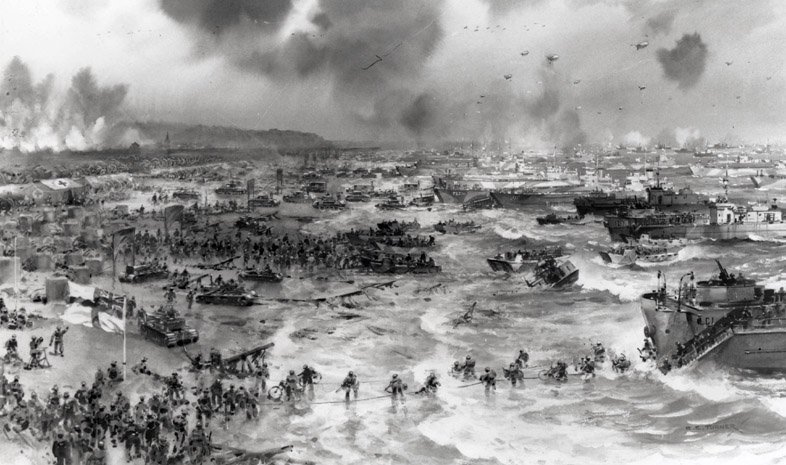
On the night of June 5th 1944 the invasion on Normandy started, planes bombing the coastland defences, while paratroopers raided the inland tasked with sabotage and disabling the bridges to stop any German forces to come in as support. The morning after the Americans, English and Canadian landed ashore. With great losses the allied forces manage to capture the beaches then started moving inland and took back France. In Asia the allied forces started to push back the Japanese in Burma and the Americans led a two frontal assault working on liberating the Philippines and the other Japanese controlled islands.

Shores of Normandie Invasion day
Shores of Normandie After the Allied won

Back in Europe the allies was making progress and was starting to capture German land, Hitler tried to push back in a last attempt, but suffered heavily. This was the end of Hitlers campaine and with Soviet Union on the east and the allied on the west, Hitler lost the war.

Now it was only Japan left. The Americans fought hard when taking over the Okinawa. Now they had to make a choice to keep fighting up through Japan or make them surrender. At this time the Americans had gotten their atomic bomb tested and ready for use. So on August 6th the atomic bomb fell on Hiroshima, then on the 9th Nagasaki got hit. It was a devastating blow to the Japanese and in September they surrendered. After 6 years, war was finally over.

Written and edited by Rhea S. Pasignahen

History of video games up to the 21st cenury.

The games we have today are far from what games started out from. Since the early 1950s there have been computer games, not as fun as the fortnite that you may be playing today or as big and deep as World of Warcraft is. But rather simple games like tennis for two where you have but a simple line and a ball bouncing back and forth, with only one button and a wheel to move the plate and hit the ball.

Tennis For Two

This however quickly evolved after it became commercially available, it then made it possible to set up arcade halls. And in the 1970s you could visit and play games in a hall full of different gaming machines. In 1878 was the golden year for these halls. These arcades still exist in some countries as of today but they have for the most part disappeared. Some of these arcade games can still be seen in todays world as a mobile game, like space invaders, Breakout (Brick Braker), pinn ball games, Pac-Man etc.

Arcade Hall

As gaming grew so did the demand, and soon enough it was getting more affordable to buy a home console. This saw a new wave of games in many different genres such as platform/side scroller games like Super Mario Bros and Castlevania. Adventure/Fantacy games like The Legend of Zelda and Final Fantasy. This is just to name a few of many games and genres that came to be and would spark may more to come.

Spuer Mario Bro 1985
Castlevania 1986
Legend of Zelda 1986
Final Fantasy 1987

1989 The year of Game Boy, a handheld game console that you could bring with you where ever you went, as long as you had batteries or a charger and a power outlet. This console would go on to become the most successful handheld console ever, and made games like Pokemon very big. Games like Tetres was also a good hit on Game boy.

Game Boy 1989
Pokemon on Game Boy
Tetris on Game Boy

Meanwhile, SimCity kickstarted the city-building genre, putting the players in a town planners shoes and proving to be very enjoyable for some people. This genre have evolved much, and there are many games in and around this genre. Today names like Tropico is big inside city-building and have evolved a lot.

SimCity 1989
Tropico 6 2019

1990s Marked a increase in pace for the industry, with the new 16-bit machines, Pushing the graphics forward beyond anything people had seen before. Games improved with the new and enhanced visuals. Adventure games with the so called point and click games such as The Secret of Monkey Island 1990, a pirate adventure game made, like no text adventure game ever could before. In 1991 the Sonic the Hedgehog an iconic side-scrolling plat former made impressive visuals and in some ways still are today. Same year the Street Fighter 2 was responsible for sending the popularity of fighting games skywards.

The Secret of Monkey Island 1990
Sonic the Hedgehog 1991
Street Fighter 2 1991

Sid Meier embarked on a series of games that would certainly stand the test of time. Civilization put the players in an eternal emperors shoes as you guide your people over six millennia. This game series and genre are alive and well today with the newest release Civilization 6 Gathering Storm 2019.

Civilization 1991
Civilization 6 Gathering Storm 2019

1992s Wolfenstein 3D the start of the first-person-shooter genre (FPS). 1993s Doom, further cemented the FPS’s enduring popularity, with the high action gore filled gunplay appealing to many. You probably know some games in the genre, games like Counter Strike, Call of Duty or Battlefield which are the biggest names in FPS today.

Wolfenstein 3D
Doom
Counter Strike Global Offensive
Call of Duty Modern Warfare
Battlefield 3

The 32 bit PlayStation launched in 1994, and the new hardware provided the basis for Tekken. Building on the Sega’s Virtual Fighter whilst refining the presentation and controls. UFO Enemy Unknown was the first in the XCOM series, it successfully blended turn based strategy games with base management and research in a compelling fight against alien forces.

PlayStation
Tekken
UFO Enemy Unknown

1996 saw the launch of the Nintendo 64, and with it, perhaps the first really successful foreye into 3D platforming. That game was Super Mario 64, with the processing power to support a 3D world, and a joypad with analog precision and enough buttons to control the camera as well as the character. The game was both technically impressive and very fun to play.

Nintendo 64
Super Mario 64
Super Mario 64

1997 saw perhaps the first successful console FPS, with the much loved GoldenEye 007. The four player split screen death match making a particular highlight. The racing simulator enjoyed the polished work of Polyhony’s release of Grand Turismo, with a diverse set of cars and tracks, making for a definitive driving experience. Rockstar made there release the same year with a controversial game named Grand Theft Auto a top-down open world game, which would move on to become the most famous series within crime and theft type of game where you could steal cars, shoot people and reek havoc on the city.

GoldenEye 007
” four player splitscreen deathmatch”
Grand Turismo
Grand Theft Auto

In 1998 Valve established their early reputation with the well crafted science themed shooter, named Half Life. Playing as Gordon Freeman the player tried to escape a failed experiment inside Black Mesa research facility. The experiment had spawned head sucking aliens that took control of the human NPC (Non-player character). Similarly, science fiction and an important milestone for the RTS (Real time strategy) genre is Blizzard’s StarCraft. Transposing the earlier Warcraft into a futuristic setting with a 3 race interplay where the Terrans, (humans) Protos (higly evolved aliens) and Zerg (creeper like alien) fought between each other for dominance over the galaxy.

Half Life
StarCraft

1999 was a very good year for the FPS fans, with two arena shooters fighting for dominance. The Unreal Tournament from Epic and Quake 3 Arena from ID. By this point 3D graphics was starting to mature and so fast paced action shooters didn’t have to compromise on graphical looks. Same year the Counter Strike came into life.

Unreal Tournament
Quake 3 Arena
Counter Strike

2000 The new millennium saw both Playstation 2 and the Gamecube launch with the Xbox not far behind. While these new consoles found their place, PC (Personal computer) gaming enjoyed some notable exclusives, one of these are the story driven, demon killing, top down game Diablo 2. Same year and not so dark game is The Sims, a virtual dollhouse where you would build and take control of a family in their home.

Playstation 2
GameCube
Xbox
Diablo 2
The Sims

These are only a part of a big history of games and consoles.

Written and edited by Rhea S. Pasignahen.